


The List of Essential Duas for Umrah
The essential duas for Umrah, in order, are the travel dua, the Talbiyah, the dua on entering the mosque, supplications during Tawaf, the verse at Maqam Ibrahim, the Zamzam dua, and the duas during Sa’i at Safa and Marwah. Apart from the Talbiyah and a few set supplications, you may make any sincere dua, in any language, throughout.
Umrah is a journey of the heart as much as the body. The rituals themselves are simple, but the duas (supplications) you make along the way are where the real connection happens. Makkah is one of the most blessed places on earth, and the moments of Umrah — standing before the Kaaba, walking between Safa and Marwah, drinking Zamzam — are times when sincere prayers are especially hoped to be accepted. Learning a few key duas before you travel helps you stay present and focused, instead of fumbling with a booklet.
A calm, well-organised trip makes worship so much easier. At Islamic Travel Agency, we offer Umrah packages all-inclusive of flights, visa, hotels and transport, so the logistics are handled and you can focus on your duas and your devotion. Now, here is the list of essential duas for Umrah, step by step, with the Arabic, an easy transliteration, and the English meaning.
Before you start: an important note
One thing to know first: apart from the Talbiyah and a few supplications the Prophet ﷺ recited at certain points, there is no fixed dua required for each round of Tawaf or Sa’i. Scholars are clear that you may make any sincere dua — in Arabic or your own language, from the Quran, the Sunnah, or your own heart. The duas below are beautiful, authentic examples to guide you, not a script you must follow word for word.
1. Dua before you travel (Dua al-Safar)
Begin your journey with trust in Allah. This short Sunnah dua asks for His protection and is recited as you set off.
بِسْمِ اللهِ تَوَكَّلْتُ عَلَى اللهِ، وَلَا حَوْلَ وَلَا قُوَّةَ إِلَّا بِاللهِ
Bismillah, tawakkaltu ‘ala Allah, wa la hawla wa la quwwata illa billah.
Meaning: In the name of Allah, I place my trust in Allah, and there is no power nor strength except with Allah.
2. The Talbiyah (after entering Ihram)
Once you enter Ihram at the Miqat and make your intention for Umrah, you begin the Talbiyah. This is the signature call of the pilgrim. Recite it often — men aloud, women softly — and keep repeating it until you start Tawaf.
لَبَّيْكَ اللَّهُمَّ لَبَّيْكَ، لَبَّيْكَ لَا شَرِيكَ لَكَ لَبَّيْكَ، إِنَّ الْحَمْدَ وَالنِّعْمَةَ لَكَ وَالْمُلْكَ، لَا شَرِيكَ لَكَ
Labbayk Allahumma labbayk, labbayk la sharika laka labbayk, innal-hamda wan-ni’mata laka wal-mulk, la sharika lak.
Meaning: Here I am, O Allah, here I am. Here I am, You have no partner, here I am. Truly all praise, grace and sovereignty belong to You. You have no partner.
3. Dua when entering Masjid al-Haram
As you step into the mosque, lead with your right foot and ask Allah to open the doors of His mercy. This is the general dua for entering any mosque.
اللَّهُمَّ افْتَحْ لِي أَبْوَابَ رَحْمَتِكَ
Allahumma aftah li abwaba rahmatik.
Meaning: O Allah, open for me the doors of Your mercy.
4. Dua on first seeing the Kaaba
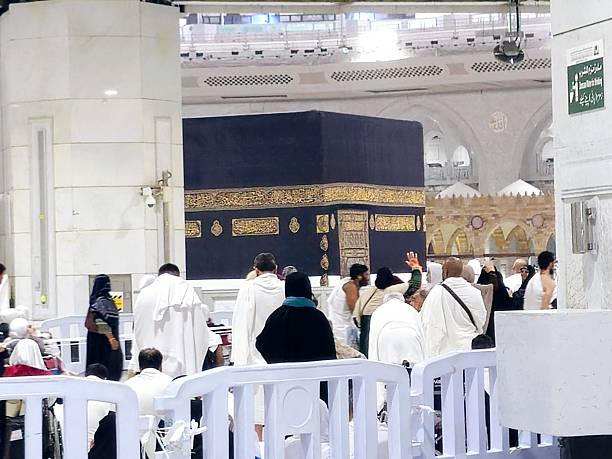
There is no single confirmed dua narrated for the moment you first see the Kaaba, but scholars agree it is a powerful time when prayers are hoped to be accepted. Raise your hands, look at the House of Allah, and pour out a sincere personal dua for yourself, your family and the whole Ummah. Many pilgrims also say “Allahu Akbar” and “La ilaha illallah” at this moment.
5. Duas during Tawaf
Start each of the seven circuits at the Black Stone (Hajar al-Aswad). When you come in line with it, raise your hand towards it and say “Bismillah, Allahu Akbar.” There is no fixed dua for each round, so make personal supplications, recite Quran, or remember Allah throughout. The Prophet ﷺ is known to have recited this verse between the Yemeni Corner and the Black Stone:
رَبَّنَا آتِنَا فِي الدُّنْيَا حَسَنَةً وَفِي الْآخِرَةِ حَسَنَةً وَقِنَا عَذَابَ النَّارِ
Rabbana atina fid-dunya hasanatan wa fil-akhirati hasanatan wa qina ‘adhaban-nar.
Meaning: Our Lord, grant us good in this world and good in the Hereafter, and protect us from the punishment of the Fire. (Quran 2:201)
Plan your journey with peace of mind
Tawaf and Sa’i can be crowded and tiring, so a good guide and a hotel close to the Haram make a real difference to your focus and your worship. If you are planning ahead, our Umrah packages 2027 offer early dates, trusted hotels near Masjid al-Haram, and group guides who help you with the rituals and the duas. Booking early also means better prices and more choice of travel times, so you arrive relaxed and ready to focus on your supplications.
6. Dua at Maqam Ibrahim
After completing seven circuits, move towards Maqam Ibrahim (the Station of Ibrahim) and recite this part of the verse. Then pray two short rak’ah behind it if you can do so without crowding others — it is Sunnah to recite Surah al-Kafirun in the first and Surah al-Ikhlas in the second.
وَاتَّخِذُوا مِنْ مَقَامِ إِبْرَاهِيمَ مُصَلًّى
Wattakhidhu min maqami Ibrahima musalla.
Meaning: And take the Station of Ibrahim as a place of prayer. (Quran 2:125)
7. Dua for drinking Zamzam
After your two rak’ah, drink your fill of blessed Zamzam water. The Prophet ﷺ said that Zamzam is for whatever it is drunk for, so make your own dua, and many pilgrims also say this well-known supplication.
اللَّهُمَّ إِنِّي أَسْأَلُكَ عِلْمًا نَافِعًا، وَرِزْقًا وَاسِعًا، وَشِفَاءً مِنْ كُلِّ دَاءٍ
Allahumma inni as’aluka ‘ilman nafi’an, wa rizqan wasi’an, wa shifa’an min kulli da’.
Meaning: O Allah, I ask You for beneficial knowledge, abundant provision, and healing from every illness.
8. Duas during Sa’i (Safa and Marwah)
Next comes Sa’i: walking seven times between the hills of Safa and Marwah. As you approach Safa for the first time, recite this verse:
إِنَّ الصَّفَا وَالْمَرْوَةَ مِنْ شَعَائِرِ اللَّهِ
Innas-Safa wal-Marwata min sha’a’irillah.
Meaning: Indeed, Safa and Marwah are among the symbols of Allah. (Quran 2:158)
Then say, once, “Abda’u bima bada’allahu bih” (“I begin with that which Allah began with”). Climbing Safa and Marwah, face the Kaaba where you can and recite the following, then make your own personal duas during each lap.
للَّهُ أَكْبَرُ، اللَّهُ أَكْبَرُ، اللَّهُ أَكْبَرُ، لَا إِلَهَ إِلَّا اللَّهُ وَحْدَهُ لَا شَرِيكَ لَهُ، لَهُ الْمُلْكُ وَلَهُ الْحَمْدُ وَهُوَ عَلَى كُلِّ شَيْءٍ قَدِيرٌ
Allahu Akbar, Allahu Akbar, Allahu Akbar. La ilaha illallahu wahdahu la sharika lah, lahul-mulku wa lahul-hamd, wa huwa ‘ala kulli shay’in qadir.
Meaning: Allah is the Greatest (three times). There is no god but Allah alone, with no partner. His is the dominion and His is the praise, and He is able to do all things.
9. After Umrah: Halq or Taqsir
Your Umrah ends with cutting the hair. Men shave the whole head (Halq, which is preferred) or trim it evenly (Taqsir); women trim about a fingertip’s length from the end of their hair. There is no fixed dua for this step — simply thank Allah for allowing you to complete your Umrah, and make a heartfelt dua of gratitude.
When are duas most likely to be accepted?
Throughout Umrah, certain moments are especially blessed for supplication. Make the most of them:
• When you first see the Kaaba
• During Tawaf around the Kaaba
• At the Multazam (the area between the Black Stone and the door of the Kaaba)
• After praying behind Maqam Ibrahim
• On the hills of Safa and Marwah during Sa’i
• After drinking Zamzam water
• While in sujood (prostration) during your prayers
Tips for making dua during Umrah
• Learn a few duas by heart before you fly, so you are not distracted searching for them.
• Make dua in your own language too — Allah understands every tongue and every intention.
• Keep a short list of people and needs to pray for, so you do not forget anyone.
• Raise your hands and face the Kaaba where you can, and pray with full focus.
• Do not rush. Being present with your heart matters more than the number of words.
FAQs: essential duas for Umrah
Q: Is there a specific dua for each round of Tawaf?
A: No. Scholars agree there is no fixed dua for each circuit of Tawaf or Sa’i. You may recite Quran, dhikr, or make personal duas in any language. The verse “Rabbana atina…” is recommended between the Yemeni Corner and the Black Stone.
Q: What is the most important dua in Umrah?
A: The Talbiyah (“Labbayk Allahumma labbayk…”) is the key recitation, said often from the moment you enter Ihram until you begin Tawaf.
Q: Can I make dua in English during Umrah?
A: Yes. You can make personal duas in any language. Reciting the set Arabic supplications is rewarding, but heartfelt prayers in your own words are also accepted.
Q: What dua do you read when you first see the Kaaba?
A: There is no single confirmed narration for this moment. Raise your hands and make a sincere personal dua, as it is a time when prayers are hoped to be accepted.
Q: Do women recite the Talbiyah out loud?
A: Women recite the Talbiyah softly, while men are encouraged to raise their voices.
Final words
The duas of Umrah are simple, but they carry the weight of standing in the most blessed places on earth. Learn the key ones, keep your heart present, and do not be afraid to pour out your own prayers in your own words. With Islamic Travel Agency, your travel, visa and hotels are arranged for you, so your mind is free for what truly matters — your worship and your dua.
May Allah accept your Umrah, answer your duas, and grant you a safe and blessed journey.