

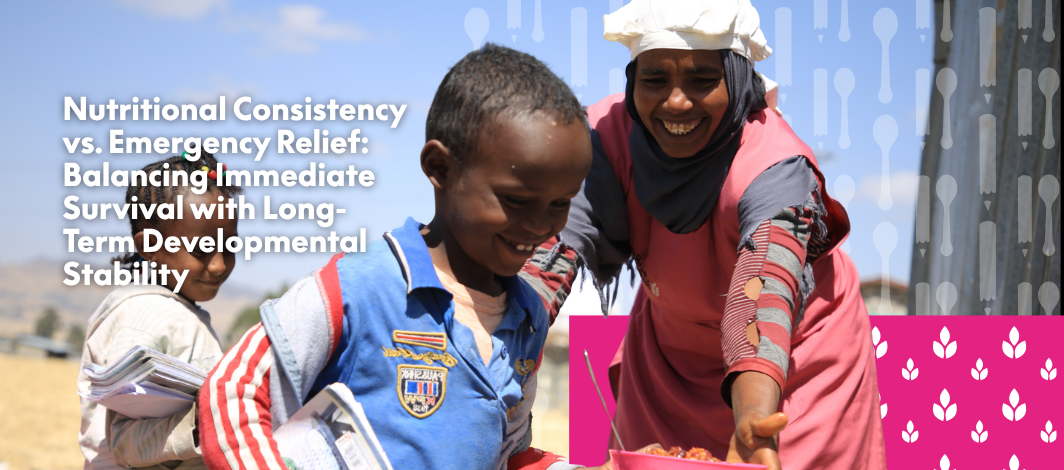
The central question for this piece is simple. When should a response prioritise immediate food relief, and when should it build nutritional consistency around school routines so that children can learn and grow with stability?
Across the school feeding and education ecosystem, both approaches exist for good reasons. Emergencies demand speed and coverage. Long-term development requires reliability and structure. The right path depends on context, constraints, and what a community needs at that specific moment.
Two anchors in one ecosystem
Nutritional consistency through school meals
In many places, the most effective way to remove hunger as a barrier to learning is to make meals part of the school day. A predictable meal in a known place creates a dependable routine. It supports attendance, helps children concentrate in lessons, and gives families confidence that school offers safety and dignity alongside learning.
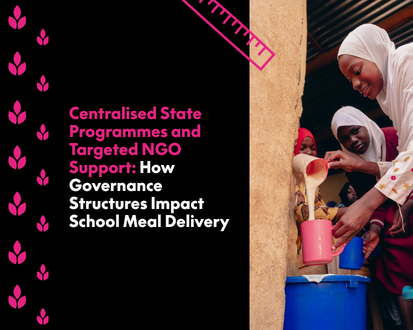
Delivering that predictability is a systems challenge. It relies on stable supply chains, safe kitchens, and clear roles for schools and partners. In Pakistan, for example, Charity Right operates a centralised kitchen model. Meals are prepared off site in purpose equipped facilities, then delivered daily to selected schools. This setup supports consistent meal quality, adherence to food safety standards, and streamlined logistics. It also allows careful planning of menus and quantities, which helps control costs and manage seasonal changes in supply.
Where schools are stable and accessible, this approach places meals directly within the education day. We work with trusted educational partners and monitor indicators that reflect the link between meals and learning environments. That includes daily attendance, examination results, and body mass index, which help us refine delivery over time.
Emergency relief to protect life and reduce immediate harm
When conflict, disaster, or sudden displacement disrupts daily life, the priority shifts to survival and quick stabilisation. Kitchens may be damaged, markets may be closed, and schools may be shut or operating intermittently. In these settings, emergency cooked meals or other short term food support are often the most practical options. They can be set up quickly, reach large groups, and reduce the risks that come with acute hunger.
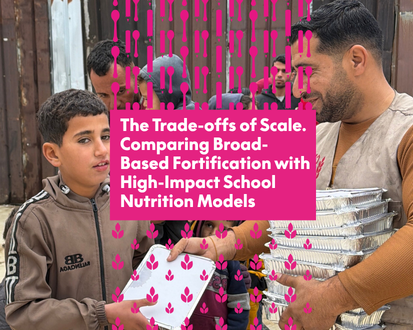
Charity Right has adapted in this way where needed. In Palestine, our work has included emergency cooked meals with a view to restarting school based meals when conditions allow. The emphasis is on meeting immediate needs first, then rebuilding the predictable routines that support education as stability returns.
Why no single approach fits every context
Communities face different types of pressure. The right food support model depends on how those pressures shape daily life and schooling.
- Acute crisis and displacement. Speed, simplicity, and reach matter most. Emergency cooked meals can be delivered in temporary sites or through community partners, often with limited infrastructure.
- Recovery after shock. As schools reopen and transport stabilises, delivery can move toward more structured provision. This is a transitional phase where both emergency and school based approaches may operate side by side.
- Chronic poverty in relatively stable settings. Predictable, school based meals can be integrated into the school day and supported by dedicated kitchen systems. Centralised kitchens, like those used in Pakistan, enable quality control and routine delivery.
- Urban and peri urban areas. Dense populations can support centralised kitchens and planned distribution routes. This suits consistent menus and defined delivery times.
- Remote or highly insecure locations. Flexibility and smaller footprints become important. Temporary cooking points or simplified menus may be necessary until conditions improve.
Trade offs that shape real world choices
Every approach carries trade offs. Understanding them helps explain why different models sit alongside each other in the same country or region.
- Predictability and routine versus flexibility and reach. School based meals offer a dependable daily rhythm that supports attendance. Emergency relief can start fast and expand quickly, but may vary by day and site.
- Standardised quality versus local variation. Centralised kitchens support consistent safety and portioning. Emergency cooking can be more variable, which may be necessary when supply lines are disrupted.
- Capital investment versus operating intensity. Purpose built kitchens require upfront investment and planning. Emergency relief often has lower setup costs but needs higher day to day coordination and can be more exposed to supply shocks.
- Direct link to classrooms versus general coverage. School meals embed food within learning time. Emergency relief may reach wider populations, including out of school children, when classrooms are closed or unsafe.
How Charity Right fits within this landscape
We deliver regular, nutritious school meals to children in underserved, crisis affected, or chronically poor communities. Our work sits at the intersection of food security, education, and child protection. It aligns with global frameworks that recognise the role of food in education, including the United Nations Sustainable Development Goals related to hunger, quality education, and gender equality.
Our operating logic is simple. Meals at school support attendance, which supports learning, which protects dignity and builds opportunity over time. To make that practical, we work with trusted educational partners and select schools that can provide a safe learning environment. We track daily attendance, examination results, and body mass index, which helps us maintain a steady standard and improve delivery.
Where the context allows, we use centralised kitchens to secure consistency and food safety. In Pakistan, meals are prepared off site and delivered daily to schools, supporting reliable menus and controlled logistics. In Turkey, our programme supported three schools that serve Uyghur students in 2024, delivering approximately 168,000 meals over the year. Menus often included rice or bread, eggs, vegetables, and fruit, designed to meet the needs of growing children within a school day routine.
We also adapt in crises. In Palestine, we have delivered emergency cooked meals with the intention of restarting school meals when conditions on the ground improve. This reflects a wider pattern in the sector. When safety, access, or schooling are disrupted, immediate relief is the right first step. As stability returns, rebuilding predictable, school linked meals helps children return to learning with structure and care.
Why both approaches matter together
Across the ecosystem, many actors work along a spectrum that runs from emergency relief to long term, school based delivery. The aim is not to choose one approach forever. It is to match the approach to the moment, then to shift as conditions change.
Emergency cooked meals reduce immediate harm. They protect life, buy time, and keep communities engaged when schooling is interrupted. Nutritional consistency through school meals builds a stable foundation for attendance and learning. It is a commitment to reliability that children and families can plan around.
In practice, communities often move between these modes more than once. Conflict can flare, floods can return, markets can fail. Each change brings a new assessment of risk, access, and the role that schools can play. The goal is a smooth handover from one model to the other, with clear communication and practical logistics throughout.
What this means for readers
Understanding the difference between emergency relief and nutritional consistency helps explain how programmes evolve. It shows why a school meal charity may deliver hot meals in a temporary site this term, then rebuild a centralised kitchen route next term. It also highlights the patience and planning required to keep meals linked to education in places that face repeated shocks.
At Charity Right, we commit to reliability where possible and flexibility where necessary. We build systems that can deliver daily meals within schools, and we adapt to emergency cooked meals when safety and access demand it. The two approaches are not in competition. They are parts of one effort to ensure that hunger does not block a child’s path to the classroom, today or tomorrow. Help us turn emergency aid into a lasting opportunity.