

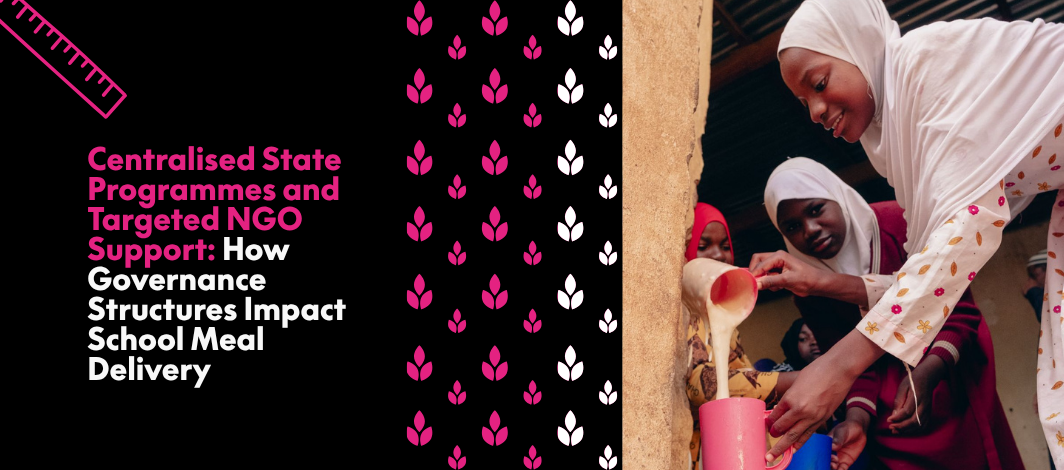
A question often sits behind debates on school meals programme: what determines whether meals are best delivered through a nationwide, centralised state programme or through targeted NGO support linked to specific schools and communities? The answer usually comes down to governance structures, the reliability of delivery systems, and the context a child is growing up in.
School meals are not just a plate of food. In many places they are the difference between attending school or staying at home. Meals support attendance, help children stay through the school day, and create a stable platform for learning. Over time, that reliability can open pathways to dignity and opportunity. Different delivery models have grown around this simple idea, each shaped by how decisions are made, how supply chains are managed, and how schools are supported.
Two broad models shaped by governance
Centralised state-led programmes
In this model, government agencies set standards, manage procurement, and coordinate distribution to public schools at scale. The core assumption is that national systems can provide wide coverage, use public budgets, and align meals with education policy. When stable public finance, clear mandates, and reliable logistics are in place, a centralised programme can provide consistent entitlements to large numbers of children. Menu norms and food safety standards can be applied uniformly, and planning ties directly into the school calendar.
These programmes also carry specific constraints. National supply chains need to function through seasonal changes and market shifts. Delivery must remain reliable across remote and urban schools. Adjusting menus or targeting can take time because changes move through formal policy channels. The strengths of scale and stability sit alongside the reality that one national design may not fit every local context equally well.
Targeted NGO delivery linked to education
NGO models tend to start from the school level and build up. The core assumption is that context varies and some children study beyond the reach of consistent state provision, especially in underserved, crisis-affected, or chronically poor communities. NGOs often work with selected schools, choose menus and delivery schedules suited to local conditions, and adapt quickly when needs change. Targeting allows resources to go where the gap is most pronounced, whether that is a remote rural cluster or a displaced community studying in a host country.
Targeted delivery also has trade-offs. It is not designed to replace universal state entitlements. Coverage is defined by partnerships and resources, and coordination with the wider education system requires active information sharing. The strengths of specificity and agility sit alongside the need for careful school selection, reliable daily delivery, and transparent monitoring.
How delivery choices interact with education
No matter the model, the education link is what gives school meals their power. Consistent meals reduce a core barrier to attendance. That reliability keeps children in class and supports concentration through the school day. Over time, improved attendance supports learning progress and gives families the reassurance that at least one meal is secured. The sequencing is simple: meals improve attendance, which supports learning, which builds dignity and creates opportunity.
Where Charity Right sits in this landscape
Charity Right delivers regular, nutritious school meals in underserved, crisis-affected, or chronically poor communities. We work with trusted educational partners in carefully selected schools that offer a quality learning environment. This approach helps us build reliable, school-based delivery and align meal times with the rhythm of teaching and learning. We monitor daily attendance, examination results, and body mass index to understand whether meals are reaching children consistently and to refine implementation over time.
Our work sits at the intersection of food security, education, and child protection. In 2024 we operated in seven countries, including Afghanistan, Bangladesh, Ethiopia, Malawi, Pakistan, Palestine, and Turkey. The settings differ, yet the organising logic remains the same: consistent school meals, linked to learning, delivered through partners who can manage day-to-day reliability.
Governance in practice: three contexts
Turkey
In Turkey, Charity Right supported three schools serving Uyghur students with daily meals in 2024, delivering approximately 168,000 meals across the year. This is a clear example of targeted NGO support. The focus is on a defined learner group studying in specific schools, where a daily meal can help stabilise attendance and reduce pressure on families. The governance lens here is school-centred. Decisions about menus, delivery timings, and tracking are taken with partner schools so that the meal reliably reaches the classroom where it is needed.
Malawi
In Malawi, our programme delivered approximately 1,201,934 meals in 2024. While the country context and partner mix differ from Turkey, the delivery logic is similar. We select schools carefully, align meals to school schedules, and monitor simple indicators to check that children are present and learning. This is a targeted contribution within a national education landscape, designed to be steady and predictable for the schools we serve. The governance frame emphasises reliability at the school level, supported by routine oversight and data from partners.
Dhaka, Bangladesh
In Dhaka, we delivered approximately 218,954 meals in 2024. Urban settings introduce distinct logistics, from storage constraints to traffic patterns that affect delivery times. Here, governance is about matching a predictable meal service to the tempo of city schools and safeguarding that service during disruptions. Targeted support complements local efforts by focusing on specific partner schools that can translate a daily meal into improved attendance and classroom stability.
Why different approaches exist side by side
The presence of both centralised and targeted models reflects the variety of education systems and the realities children face. Centralised programmes fit contexts where public systems can reliably finance, procure, and distribute at scale. They embed meals within national education policy and reach public schools widely. Targeted NGO delivery fits contexts where gaps appear, whether because of geography, crisis, displacement, or school-specific constraints. It focuses resources on schools where daily delivery can unblock attendance and help teachers sustain learning through the day.
Neither approach is universally right for all settings. Each carries trade-offs. Centralised delivery leans on scale and policy stability, and must invest in last-mile consistency. Targeted delivery leans on context fit and agility, and must invest in careful selection, partner capacity, and consistent follow-through. What unites the field is the goal that a child sits down to learn without hunger being the obstacle.
How we frame our role
Our role is specific. We provide regular school meals through selected partners and track simple signals of reliability and learning readiness, such as attendance, exam results, and BMI. We operate where targeted, school-based delivery can help close a gap for children in underserved, crisis-affected, or chronically poor communities. That is where a daily meal, offered consistently over time, can stabilise the school day and allow learning to take root.
Different governance structures will continue to shape how meals reach classrooms. Centralised state programmes and targeted NGO support are not opposites. They are complementary responses to different constraints. Our contribution sits on the targeted side of that spectrum, grounded in the school, aligned with education, and focused on reliability over the long term. A meal is the first step toward a classroom education.