

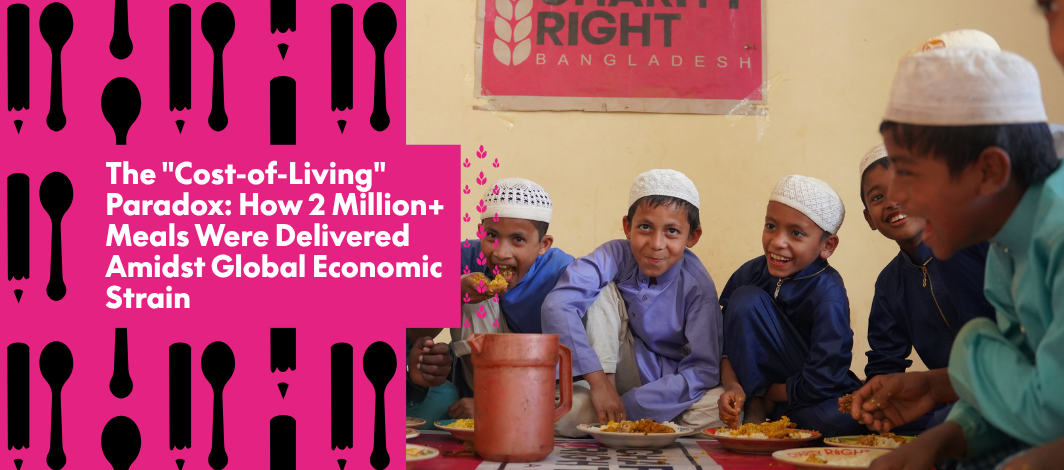
In Dhaka, Bangladesh, the school meal programme worked through 2024 against a pressure that was larger than any single kitchen budget. Global economic strain pushed up the cost of food, while local operations still had to meet the daily reality of children arriving at school needing a reliable meal. In that setting, the programme stayed focused on students in three schools and on the systems that make consistency possible: routine cooking, regular supply, and close follow-up around children’s welfare.
The school meal programme did not operate in ideal conditions. It ran at full capacity from January through April 2024, then adjusted during the seasonal period in March by shifting from lunch to evening meals to suit the community’s schedule. In May and June, Cyclone Storm Remal and heavy rains caused flooding across the city, leading to temporary school closures. Later, in August, one school was paused because of operational constraints, while the other two schools continued through to the end of the year. That pattern matters because school meals are not sustained by intention alone. They depend on cooks, school staff, and delivery planning being able to adapt when weather and timetables change.
Within those constraints, the school meal programme delivered over 219,000 meals in 2024 to 794 children, 52% of whom were girls. The value of that number lies in its regularity. When roads flood or a school closes, the challenge is not only feeding children on that day. It is preserving a dependable rhythm so that families, teachers, and students know the meal system will restart and hold. That is how a school meal becomes part of the education infrastructure rather than an occasional intervention.
The programme’s operational decisions were practical. During the seasonal period, changing the meal time helped fit local routines. When flooding disrupted access, the programme resumed and continued. When one school faced operational constraints, the remaining schools stayed open within the meal system. Those are the quiet choices that protect continuity. They also show how sustainable systems are built: school by school, kitchen by kitchen, with staff responding to the realities on the ground instead of forcing a fixed model onto an unstable context.
Teachers and school staff feel the effect of that consistency first. A meal served on time changes the school day. It helps children arrive ready to stay, learn, and participate. In Dhaka, attendance averaged 97.6% and the exam pass rate reached 87.8%. These are education outcomes, but they rest on operational discipline: food procurement that keeps moving during inflation, meal preparation that adjusts to local schedules, and programme management that absorbs disruption without losing sight of the child in the classroom.
The cost-of-living paradox is that periods of economic strain make school meals harder to deliver and more necessary at the same time. In Dhaka, the response was not to scale back the ambition of regular meals, but to keep strengthening the practical system around them. For the children in this programme, security came not from a one-off distribution, but from a school-based structure that kept returning after flooding, schedule changes, and temporary closures. That is what sustainable delivery looks like in practice.
| Country | City/Region | Target population | Schools supported | Meals delivered | Pilot period | Service frequency |
| Bangladesh | Dhaka | 794 children | 3 | Over 219,000 | 2024 | School meals, with lunch shifted to evening meals during the seasonal period in March |