

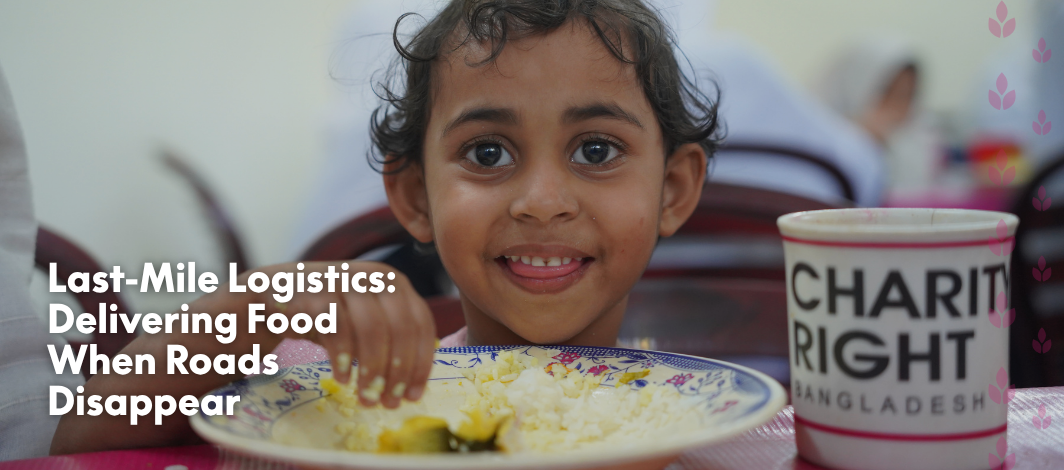
In Sylhet, Bangladesh, last-mile logistics are not an abstract problem. They are what happens when heavy rains turn access roads unreliable, when localised flooding slows journeys to school, and when a short curfew can close classrooms for two days. In 2024, Our programme in Sylhet worked through those conditions in an agricultural community, providing daily school meals to children from pre-primary through grade five.
The practical challenge in Sylhet was to keep meals dependable when the route to school was not. The school operated fully from January through May. In June, flooding temporarily impeded access. In July, political unrest led to a brief closure. Seasonal illnesses also affected some students during the monsoon period. Even with those interruptions, the programme remained operational from August to December, maintaining a system that children, teachers and families could return to as soon as school reopened.
That reliability matters because the programme is built around routine. Daily meals support both education and nutrition in a region where 36% of children are stunted and 15% are acutely malnourished. When weather and instability disrupt ordinary school schedules, the work is not only about serving food. It is about keeping a school-day structure intact so that teachers can teach, children can attend, and families know there will be a meal waiting when the road is passable again.
In 2024, the programme in Sylhet served approximately 50,000 school meals, reaching an average of 200 students each day. Attendance averaged 95.2%, and the exam pass rate reached 94.2%. Registration at the school has also risen by 30% since the meal programme began. These are operational results as much as education results. They show what can happen when a meal service is steady enough to hold its place in family decision-making, even in a flood-prone setting.
In Sylhet, sustainability depends on making the meal part of the school’s functioning rather than an add-on. The daily rhythm matters to everyone involved. Teachers can plan around a school day that includes food. School staff can keep children in a structured environment for longer. Families in a rural farming community can count on one regular point of nutritional support. In a region where seasonal flooding repeatedly interrupts livelihoods, that kind of consistency becomes part of the local support system.
Last-mile delivery in Sylhet is therefore about more than reaching a building. It is about sustaining a dependable meal service through a school calendar shaped by rain, flooding, curfews and seasonal illness. The programme’s role is to keep that system intact so that when access returns, learning and nutrition do too.
| Country | City/Region | Target population | Schools supported | Meals delivered |
| Bangladesh | Sylhet | Children from pre-primary ages to grade five, averaging 200 students daily | 1 | Approximately 50,000 in 2024 |