

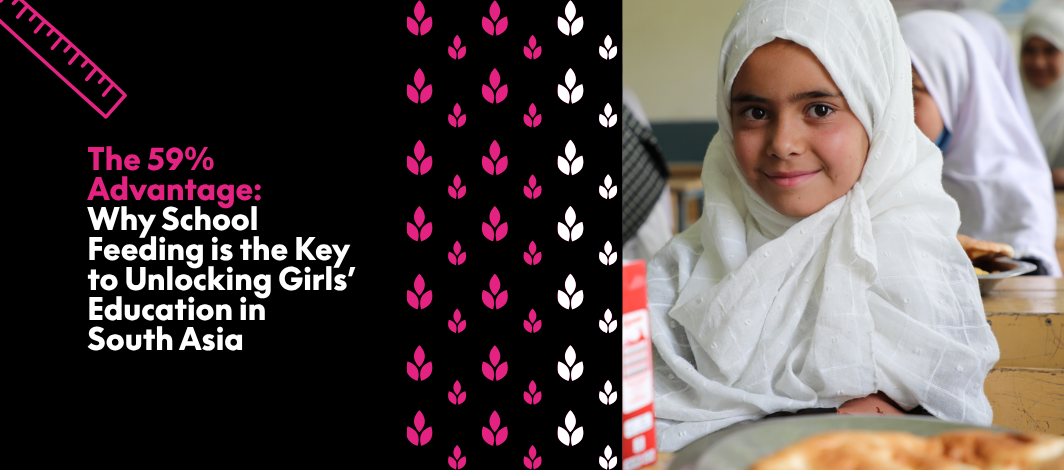
In 2024, Charity Right’s school meal programmes across South Asia showed a clear pattern: girls were more likely to stay connected to school when meals were reliable. Across all programmes, 6,753 female students made up 59% of school meals beneficiaries. In South Asia, that reality was visible in Afghanistan, Bangladesh, and Pakistan, where school feeding had to work around weather, disrupted school calendars, and fragile household incomes.
The work was practical before it was symbolic. In each location, the question was the same: how do you build enough daily certainty around food that girls can keep turning up to class? That meant cooks preparing daily meals, school staff adjusting to closures, and delivery systems holding steady through floods, curfews, storms, heat, and smog. The result was not abstract. It was attendance, enrolment, and the steadying effect of a meal that families could count on.
In Nangarhar Province, Afghanistan, the programme served 670 girls in grades one to six in 2024. The programme had transitioned from Kabul to Nangarhar to reach underserved rural communities with high nutritional needs. It operated from January to March, paused briefly during the seasonal period, then resumed in June. In July and August, flooding, storms, and heatwaves caused school closures, including 11 days of disruption in August alone. Staff responded by continuing support through 410 food parcels for families during closure periods, and when the academic term was extended through December, meals continued too. Over the year, 123,321 meals were delivered in one school, with average attendance at 98.8%.
That continuity matters particularly for girls because the barriers to education are rarely single-issue. Teachers can keep classrooms open, but if food insecurity sharpens at home, attendance becomes fragile. In Nangarhar, the decision to keep meals running through the adjusted school term was part of the education response, not separate from it. The daily meal gave families one predictable reason to keep girls in school despite seasonal disruption and wider instability.
In Sylhet, Bangladesh, the programme worked in a very different but equally unstable environment. Rural households depended heavily on subsistence farming, while climate change and seasonal flooding regularly disrupted income and food access. The school operated fully from January through May in 2024. Heavy rains caused localised flooding in June, and a short curfew related to political unrest led to a two-day closure in July. Seasonal illnesses affected some pupils during the monsoon period, but the programme continued through the remainder of the year.
In that setting, school feeding functioned as a small but dependable system around children and their caregivers. Approximately 50,000 meals were served in Sylhet in 2024, reaching an average of 200 students daily, 58% of whom were girls. School attendance had increased from 60 to 70% before the programme to a consistent 95%, while official school registration rose by 30%. Those are operational outcomes as much as education outcomes. When meals are expected each day, teachers can plan for fuller classrooms, and families facing unstable earnings have one less daily cost to absorb.
In Pakistan, the programme launched in November 2024 in Jaranwala Sub-District, Faisalabad, one of the hardest-hit areas in Punjab. The local context was severe. Faisalabad saw 45% food price inflation in 2024, while schools across Punjab were also affected by smog-related closures. In rural flood-affected areas such as Jaranwala, more than 120 schools remained non-functional. Charity Right responded with a centralised kitchen model, with meals prepared off-site in a hygienic, purpose-equipped kitchen and delivered daily to four schools.
This is where sustainable systems become visible in practical terms. A central kitchen is not only an efficiency measure. It is a way to protect food quality, standardise preparation, and keep meals moving when conditions around schools are unstable. Drivers, kitchen teams, and school staff all become part of the education chain. In its first weeks, the Faisalabad programme delivered 16,915 meals across four schools, reaching 704 registered students, including 322 girls. Even in a short launch period, that daily structure created a foothold in a district where many children are pushed out of school by pressure to work.
Across these three locations, the 59% figure is best understood not as a headline alone, but as a sign of who reaches the school gate when meals are dependable. In Nangarhar, the focus was entirely on girls. In Sylhet, girls made up the majority of children reached each day. In Faisalabad, the new delivery model established a base for regular access in a district facing inflation, damaged schools, and interrupted learning. In each case, school feeding worked because it was built as a system: kitchens, schedules, staff, and daily service aligned around the school day.
For girls’ education in South Asia, that matters because dropout is often shaped by accumulation. A flood closes a road. A curfew interrupts a week. Food prices rise. A family cuts meals. A child misses class, then another day, then more. School feeding interrupts that slide by offering security in the middle of uncertainty. One meal does not solve every barrier, but a reliable meal service gives teachers, cooks, and families something solid to organise around, and that can be enough to keep a girl learning.
When meals stop, girls are more likely to lose their place in the classroom. Your support can help protect that daily lifeline. Donate today to provide school meals and help girls across South Asia and beyond keep learning.